
Key takeaways
- AI inference is the process of using a trained AI model to produce results from new inputs.
- Inference can run locally, at the edge, or through cloud infrastructure.
- Latency, throughput, memory, model quality, and cost can all affect inference performance.
TL;DR
AI inference happens when a trained AI model receives new information and uses what it has already learned to produce an output. It powers familiar tools such as chatbots, image generators, recommendation systems, speech recognition, and computer vision applications. Unlike training, inference does not focus on teaching the model but instead, it focuses on running the model efficiently enough to provide useful results. However, where the model runs, what hardware it uses, and how it is optimized can all affect speed, cost, and overall performance. You could need a GPU server rental service, better hardware, or more scalable structures.
What is AI inference?

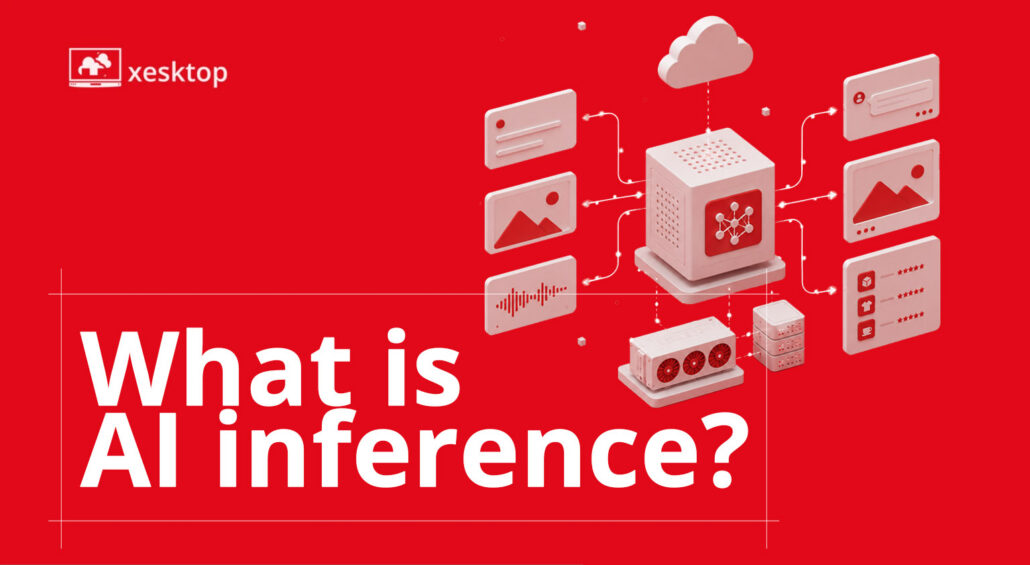
AI inference is the process of taking a model that has already been trained and using it to make a prediction, generate content, classify information, or produce another type of result from new input. In short, it’s actually using the AI model.
A simple example of inference
Imagine an image recognition model that was trained using many examples of cats and dogs. Once training is complete, you can give the model an image it has never seen before. It processes the image and predicts whether it contains a cat or a dog.
Generative AI follows the same basic idea, although the outputs can be much more complex. A text model can generate sentences, an image model can turn a prompt into an image, and a speech model can convert audio into text.
AI training vs. AI inference
Training and inference (or AI inference vs AI learning) are closely connected, but they serve different purposes in the AI workflow.

Training teaches the model
During training, an AI model processes large amounts of data and adjusts its internal parameters. These adjustments help the model identify patterns and improve its ability to perform a particular task. Training can require substantial computing power because the system may need to process the same data repeatedly while updating the model.
Inference uses what the model learned
Inference begins once the trained model is ready to handle new inputs. Instead of continually changing the model parameters, the system uses those parameters to calculate an appropriate output. Every prompt sent to a deployed language model, image generator, recommendation engine, or similar AI application can create an inference workload.
How does AI inference work?
The exact process varies between models, but most inference workflows follow a similar path from input to output.
The system receives an input
An application first sends information to the model. This could be text, an image, audio, numerical data, sensor information, or another format the model can understand.
The input is prepared
Before the model can process the information, the system may need to convert it into a suitable format. A language model, for example, divides text into smaller units called tokens (Decagon). Images and audio can also go through preparation steps so the model receives data in the format it expects.
The model processes the input
The model performs calculations using the parameters it learned during training. These calculations allow it to identify patterns and determine what output should come next.
Large and complex models can require significant computing resources during this stage, particularly when they need to process many requests at once.
The model produces an output
The final output depends on the model. A classifier might return a category, while a language model generates text and an image model generates visual data. Some applications also process the model output further before presenting the final result to the user.
Common types of AI inference
Different applications require different approaches to inference. Some prioritize immediate responses, while others focus more heavily on efficiency or the ability to process large amounts of data.
Real time inference
Real time inference processes a request and returns a result quickly enough for an interactive application. Chatbots, live translation systems, voice assistants, and some computer vision applications depend on this approach because long delays can make the experience difficult to use.
Batch inference
Batch inference processes groups of inputs together. The results do not necessarily need to appear immediately. A company might use batch inference to analyze a large collection of documents, generate recommendations for many users, or process a large dataset overnight.
Edge inference
Edge inference runs the model close to where the data is created, in terms of area/proximity. This could mean running AI directly on a phone, camera, vehicle, workstation, or another device when the source is within the region or continent, for example. Processing information closer to the source can reduce how much raw data needs to be sent to remote infrastructure and can help applications respond more quickly.
Cloud inference
Cloud inference runs models on remote computing infrastructure. Applications send requests to servers containing the computing resources required to process the model. This approach can make powerful hardware accessible without requiring every user or organization to own the same equipment locally. It can also make scaling easier when demand changes.
What hardware is used for AI inference?
AI inference can run on several types of processors. The best choice depends on the model, workload, budget, and performance requirements.
CPUs
CPUs can handle many smaller inference tasks and models that do not require large amounts of parallel computing. They are widely available and can be practical when speed requirements are modest or when the workload does not justify specialized hardware.
GPUs
GPUs are commonly used for demanding AI inference because they can perform many calculations simultaneously. Large language models, image generation systems, computer vision models, and other complex workloads can benefit from this parallel processing capability. GPU server rentals are also possible to help with performance.
AI accelerators
Some systems use processors designed specifically for machine learning operations. These include technologies such as TPUs, NPUs, and other specialized accelerators. Their purpose is generally to perform common AI calculations efficiently while balancing factors such as performance, power consumption, and memory use.
Where does AI inference run?
Choosing where a model runs can have as much impact as choosing the model itself.
Local inference
Local inference runs on hardware controlled by the user or organization. This could be a workstation, dedicated server, or private computing cluster. It can offer greater control over infrastructure and data, although performance is limited by the hardware that is available locally.
Edge inference
Edge inference moves processing closer to the source, such as in the same region or city (TechRadar). It can be useful when quick responses, limited connectivity, or local data processing are priorities. The main limitation is that edge devices like cellphones usually have less computing power or memory than large servers.
Cloud inference
Cloud infrastructure allows inference workloads to access remote CPUs, GPUs, accelerators, and larger pools of memory. It can be particularly useful for large models, changing workloads, or projects that require more computing power than local hardware can provide.
Challenges of AI inference
AI inference can become more demanding as models grow and more users rely on them. Larger models often need more processing power and memory, while high request volumes can make it harder to maintain fast response times without overprovisioning hardware.
Cost, energy use, privacy, and security also matter. Inference creates ongoing computing expenses whenever a model is used, and the infrastructure behind it consumes power. Where inference runs can also affect how data is stored, transmitted, and protected.
AI inference and generative AI
Generative AI has made inference especially visible because users interact directly with models and expect results quickly. A language model may need to perform repeated calculations while generating a response token by token. Image, audio, and video generation models can also require substantial computing resources every time new content is created.
As these applications serve more people, inference efficiency has a direct effect on how quickly results appear and how much infrastructure is required to support them.
How to choose an AI inference setup
There is no single inference configuration that works best for every AI project. A smaller model running on local hardware may be enough for one application, while another may require multiple GPUs, scalable cloud infrastructure, or server rentals.
So start with the workload itself: consider the size of the model, available memory, expected request volume, response time requirements, privacy needs, infrastructure costs, and whether demand is likely to change. The goal is to provide enough computing capacity for the model to perform reliably without spending resources that the application does not need.
Run AI inference without buying the hardware
Large models and GPU intensive inference workloads can quickly exceed the memory or computing power available on a local machine. Xesktop provides access to dedicated GPU workstations without requiring users to purchase, upgrade, or maintain the hardware themselves. NVIDIA RTX PRO 6000 Blackwell workstations are available with 96 GB of VRAM per GPU, with dual GPU configurations providing up to 192 GB of total VRAM.
Users can install their own models, tools, and software on the remote Windows workstation, while their environment and storage remain available between sessions. This makes it useful for workloads such as local LLM inference, image generation, ComfyUI, computer vision, and other demanding AI applications. Since users pay while the workstation is running, additional GPU resources can be used when a project needs them without committing to new local hardware.
Final thoughts
AI inference is the part of the AI lifecycle that turns a trained model into something people can actually use. It takes new input, processes it through what the model has already learned, and produces a useful result.

As AI becomes part of more software, devices, and everyday workflows, inference performance will continue to influence how practical those applications are. Faster processing, efficient models, suitable hardware, and thoughtful deployment choices can make AI systems easier to scale while keeping response times and computing costs manageable. When local hardware is not enough for a particular workload, services such as Xesktop can provide access to additional GPU resources without requiring an investment in new hardware.